
We develop ERP solutions that fit your processes exactly and serve as a stable basis for growth, integration and digital process control.


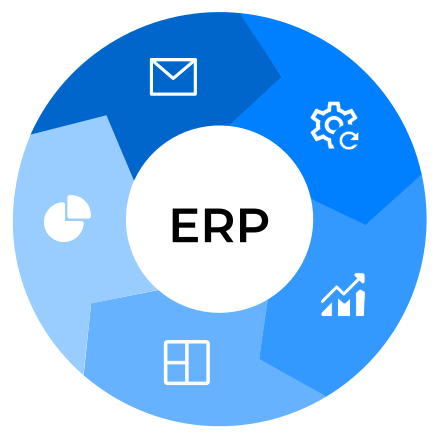
ERP systems (Enterprise Resource Planning) control central business processes such as purchasing, production, warehousing, sales and accounting. While standard ERP solutions often offer generic functions, tailor-made ERP system development that is precisely tailored to company-specific processes — without compromises.
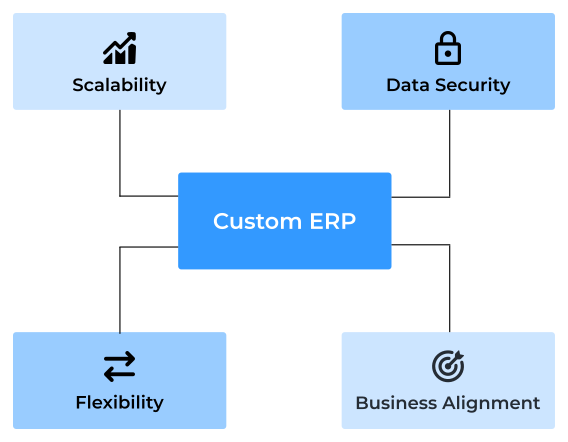
Individual ERP system development is particularly useful when processes are highly individualized or multiple systems need to be integrated. Standard solutions are often not enough here.
Performance problems, lack of interfaces, or limited adaptability can slow down growth.
An individually developed ERP system grows with the company — functionally and technologically.
We provide holistic support for ERP projects — from analysis to long-term development.
Recording of existing business processes, identification of optimization potential.
Planning a scalable and maintainable ERP architecture.
Development of tailor-made Modules for:
Digital control of purchasing, inventory and material flows for continuous processes in warehouse and procurement.
Planning of resources, capacities and production orders in order to reliably manage delivery dates and workload.
Illustration of central financial processes from document entry to evaluation with a clean database for financial statements and transparency.
Role-based key figures and dashboards for well-founded decisions in real time.
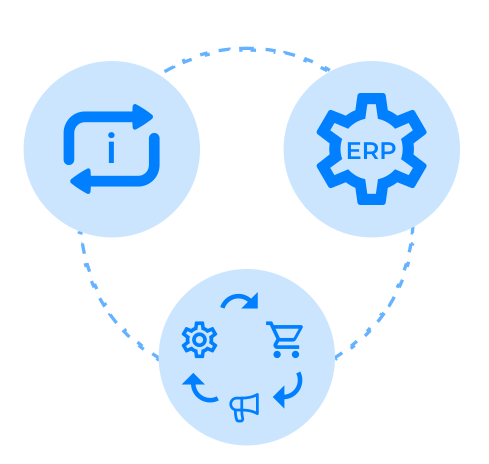
Modern business software rarely operates in isolation. Systems such as CRM, ERP, e-commerce platforms and warehouse management solutions must interact reliably to support consistent and efficient business processes.
We design and implement stable interfaces and service-oriented architectures that enable secure, structured data exchange between systems. Our approach considers both existing IT landscapes and future expansion requirements — from API integrations to the connection of cloud-based platforms.
The result is a consistent, scalable system environment that eliminates data silos, reduces redundancy and ensures seamless end-to-end processes.
Standard ERP systems offer predefined modules that are sufficient for many companies. However, as soon as processes are complex or industry-specific, these solutions often reach their limits.
Standard solutions often require compromises or workarounds. An individual ERP represents your processes precisely digitally — without workarounds or unnecessary complexity.
Standard ERP systems often incur additional license or module fees.
Individual solutions create clear investment structures without hidden dependencies.
Further developments in standard solutions are usually linked to manufacturer cycles. With an individual ERP, you retain full control over expansions, priorities and technological orientation.
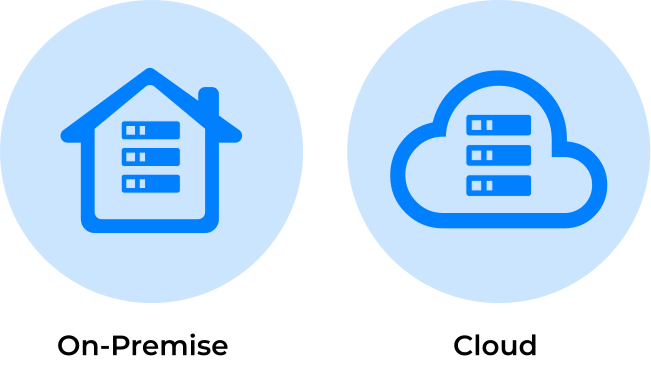
Modern ERP systems are based on flexible architectures so that they can be maintained, integrated and operated securely in the long term.
Functions are structured in clearly defined modules so that expansions can be carried out gradually and with little risk.
The operating model is adapted to your company's compliance, security requirements and IT strategy.
Granular role and rights concepts protect sensitive data and ensure comprehensible access.
The development of an individual ERP system requires a structured and transparent approach. From initial requirements analysis to productive implementation, we support projects in clearly defined phases — tailored to your processes, priorities and strategic goals.
ERP functions are implemented in clear stages, validated and gradually transferred to productive operation.
Departments are involved early on so that requirements are implemented precisely and practically.
From structured quality assurance to the planned go-live to continuous development, the ERP system remains stable, high-performance and expandable in the long term.
Would you like to check how an individual ERP system can actually improve your processes? In a non-binding discussion, we will show you which next steps make sense and what a realistic implementation can look like.
Modern business software based on C# and .NET — scalable, high-performance and future-proof. We develop individual backend and web solutions for sustainable system architectures.
Further develop existing systems instead of replacing them: We gradually modernize established software structures and make your IT fit for the future — stable, secure and predictable.
Would you like to learn more about how an individual ERP system can optimize your business processes?
Get in touch with us.


