
We revise existing software in a structured and technically sound way so that your systems remain powerful, maintainable and future-proof.


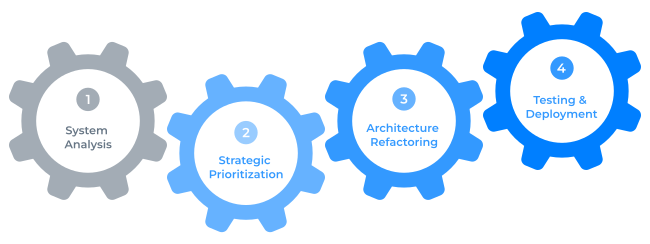
Software reengineering describes the structured revision and improvement of existing software systems. The aim is to modernize the architecture, code base and technical basis without completely redeveloping the proven business logic.
In contrast to completely new development, reengineering focuses on targeted transformation.
The system is functionally stable but is based on outdated technologies or architectures. Further developments are becoming increasingly complex and risky.
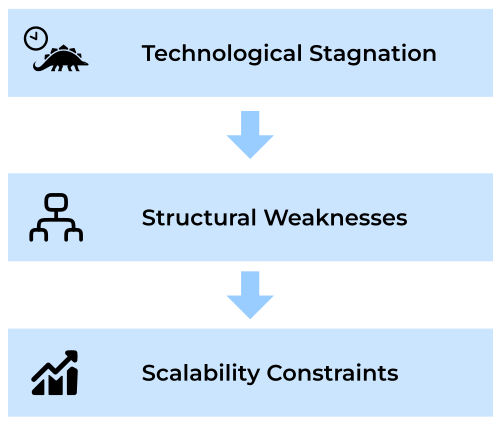
Unclear dependencies, lack of modularity or lack of documentation make maintenance, expansion and integration of new functions difficult.
Planned functional enhancements, increasing user numbers or new interface requirements make a fundamental technical revision necessary.
Software reengineering includes targeted technical interventions to structurally improve existing applications and further develop them in a future-proof manner. Depending on the initial situation, different measures are used.
Existing code is structurally cleaned and simplified without changing the technical logic. Technical debt is reduced and a stable basis is created. The aim is to sustainably improve software through structural adjustment and stabilization.
Existing structures are decoupled and modularized. Clear interfaces and defined responsibilities increase maintainability and expandability. This is often a central step within a comprehensive Software Modernization.
When platforms reach their limits, there is a controlled migration to modern frameworks or runtime environments — for example as part of a Delphi Modernization or FoxPro Modernization. The goal is long-term stability and scalability.
Bottlenecks are analysed and optimised in a targeted manner. Runtime, resource efficiency and system stability are noticeably improving — especially with growing Legacy Systems.
Depending on the initial situation, software reengineering can be an efficient alternative to completely new development.
• Existing business logic is retained
• Step-by-step modernization instead of system breakage
• Predictable project risk
• Faster implementation cycles during ongoing operations
• Complete architectural realignment possible
• No technical burdens or dependencies
• Higher investment and longer project duration
• Useful for completely outdated system landscapes
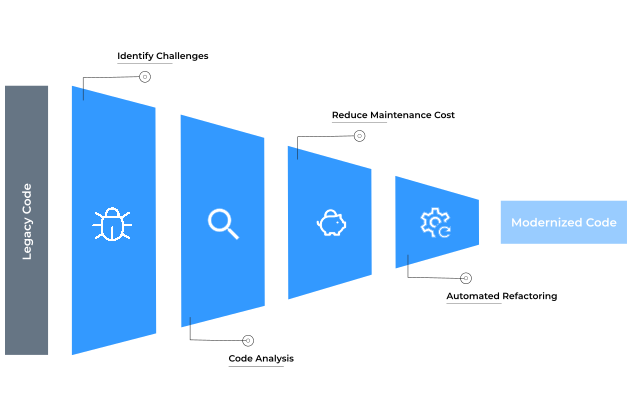
Reengineering is more than just a technical overhaul.
It combines structural analysis, architectural realignment and targeted technological development into a controlled modernization strategy.
Unlike a complete redevelopment, proven business logic is preserved while the codebase and system architecture are systematically decoupled and modernized. The result is a sustainable, maintainable, and scalable system landscape — without unnecessary system disruption.
Whether reengineering makes sense depends on the technical status of the application, its strategic significance and the desired degree of change. On this basis, a modernization strategy is created that combines stability and development.
Would you like to check whether a structural revision of your existing application makes sense?
In a non-binding discussion, we analyse the code base, architecture and modernization potential and develop a realistic transformation strategy.
Modern business software based on C# and .NET — scalable, high-performance and future-proof. We develop individual backend and web solutions for sustainable system architectures.
Would you like to know whether your existing application should be modernized or rethought? We analyse technical risks and economic effects — transparently and comprehensively.
Get an offer


