
We modernize established Delphi applications in a structured manner, reduce technical risks and create a sustainable basis for future requirements.


Many companies have been using individually developed Delphi applications for years. These systems are stable and deeply integrated into existing business processes — but are often no longer technologically future-proof.
Targeted Delphi modernization makes it possible to preserve proven applications while structurally developing architecture, performance and scalability. Instead of a complete system replacement, the existing solution is being technically redesigned and made fit for the future.
The underlying Delphi development environment is also analyzed and adapted to ensure maintainability, integration and long-term expandability.
Existing Delphi applications are often business-critical, but are increasingly reaching technological and structural limits.
Older versions of the Delphi development environment and historical architectures make sustainable development difficult. Performance, stability, and scalability come under increasing pressure as requirements increase.
Modern APIs, cloud systems or web front ends can only be integrated to a limited extent in monolithic or heavily coupled structures. The connection to new digital processes is becoming complex and prone to errors.
Know-how is often highly personal, while documentation and code structure have grown over the years. Changes involve increased risks, and further developments are becoming increasingly complex and difficult to plan.
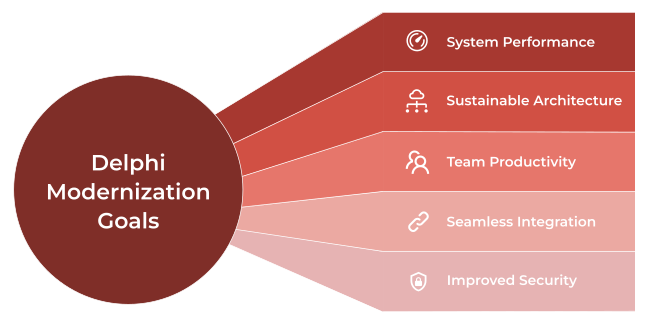
Sustainable Delphi modernization includes various technical measures — from structural code optimization to integration into modern system landscapes.
The existing code base is analyzed, cleaned and modularized. The aim is to reduce technical debt, clear responsibilities in code and a long-term maintainable architecture. This measure often forms the basis for further Software Reengineering.
Monolithic or closely coupled structures are decoupled and gradually converted into modular architectures. Dependencies are reduced and expandability is systematically improved — especially in conjunction with modern Software Modernization.
Existing user interfaces are being technically revised and adapted for current usage scenarios. Desktop applications are optionally prepared for web or hybrid environments and integrated into modern runtime environments.
Delphi systems are integrated into existing ERP, CRM or cloud landscapes via standardized APIs. This creates continuous processes without media breaks — for example in conjunction with ERP System Development or CRM Development.
Modernizing existing Delphi applications is not an isolated technical step, but part of a long-term IT strategy. The decisive question is how established systems can be converted into modular, scalable architectures without jeopardizing operational stability.
Modern system landscapes rely on clear interfaces, loose coupling and flexible expandability. A structured Delphi modernization creates the basis for gradually embedding existing applications into such architectures.
This creates a reliable balance between technological development and operational continuity.
Not every existing system needs to be replaced. The decision between modernization and complete new development depends on the technical status, strategic significance and the desired degree of change.
• Maintaining existing business processes
• Step-by-step development
• Reduced project risk
• Focus on structural improvement
• Suitable for stable old systems
• Complete architectural realignment
• No technical issues
• Higher expenditure of resources and time
• Technology change (e.g. C#/.NET)
• Useful when the system base is structurally unsustainable
Would you like to check how your existing Delphi application can be structurally modernized without jeopardizing operational stability? In a non-binding discussion, we analyse the code base, architecture and technological perspective of your application and develop a realistic modernization strategy.
Specialized Delphi developers are available to stabilize, further develop or prepare for the modernization of existing applications. They assist with analysis, refactoring and gradual technical transformation.
In addition to the structural overhaul, we also look at the technological integration of your application within the existing system landscape.
Would you like to know whether your Delphi application should be modernized, migrated, or refocused? We analyse technical risks and develop a reliable basis for decision-making.
Get an offer


