
Legacy software and established legacy IT structures are often business-critical, cause increasing risks and limit digital development. We support the structured modernization of your existing system landscape.


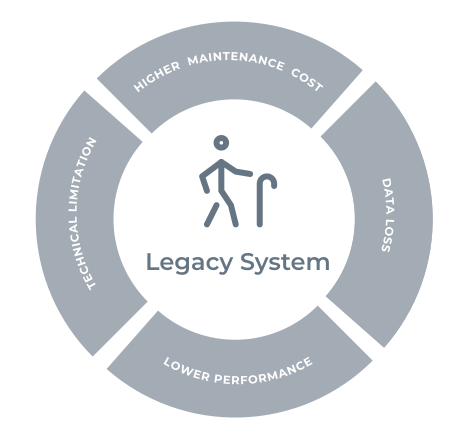
Legacy software is the term used to describe IT systems that have developed over many years and continue to control business-critical processes.
These systems are often based on outdated technologies, individual adaptations and historically developed architectures. Despite their age, they are often deeply integrated into business processes.
The term legacy IT describes the entire historically developed IT landscape of a company.
Existing IT structures often continue to fulfill their purpose, but present structural challenges.
Rigid, closely linked structures make modular expansions or gradual modernization difficult.
Custom developments that have grown over the years without clear system logic or standardization.
Manual processes and workarounds replace integrated, digital processes.
Inadequate documentation and historically developed structures make analysis and development difficult.
Legacy software involves technical, economic, and strategic risks. Without targeted modernization, costs, security vulnerabilities, and pressure to innovate are constantly increasing.
New digital products, services or integrations can only be implemented with great effort. Time-to-market is significantly extended.
Outdated systems are more vulnerable to security breaches and system instabilities. Business interruptions can cause direct economic damage.
Increasing maintenance costs and short-term workarounds tie up resources that are missing for strategic development.
Depending on the initial situation, a targeted legacy update may be sufficient to technologically renew existing systems without a complete system replacement.
Targeted Replacement of Critical Components
Individual modules or interfaces are gradually modernized, while the core of the system continues to run stably. Ideal for minimizing risks during ongoing operation.
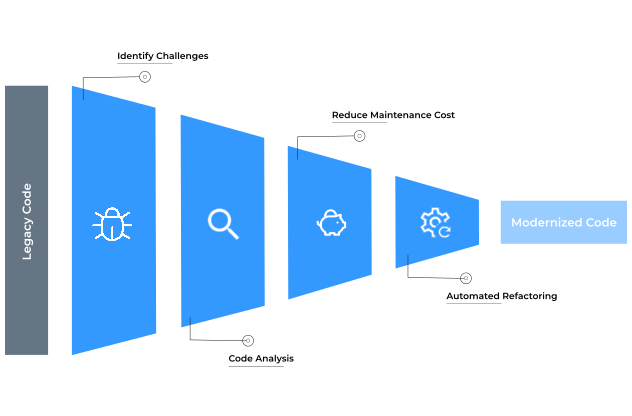
Structural Overhaul while maintaining Business Logic
Existing functions are being transferred to a modern architecture. Business processes are retained and technological dependencies are reduced.
Strategic Shift to future-proof Technologies
Existing applications are migrated to modern platforms such as .NET or cloud-enabled architectures. The goal is long-term scalability and maintainability.
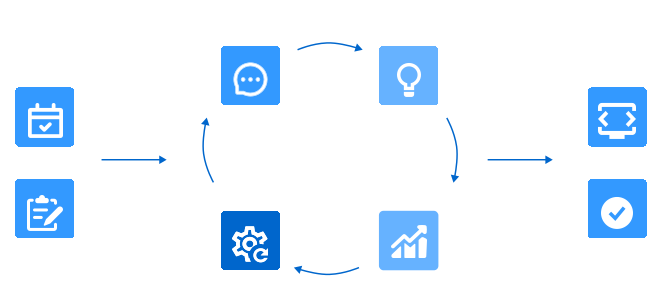
Modern software development makes it possible to further develop existing systems in a controlled manner and to address structural weaknesses in a targeted manner. The focus is on stability, security and long-term scalability.
A structured legacy update is often the first step of a sustainable modernization strategy.
Would you like to check how existing legacy systems can be further developed in a future-proof manner without jeopardizing business processes? In a non-binding discussion, we analyse your system landscape and show which modernization strategy makes technical and economic sense.
Modernize existing Delphi applications rather than replace them. We transform established structures into future-proof architectures.
Transform outdated FoxPro systems sustainably. Gradual migration or complete realignment—with minimal operational risk.
Would you like to know whether your existing system should be modernized or replaced?
We analyse risks, costs and potentials — transparently and realistically.


