
Organizations face the challenge of handling personal and sensitive data in a legally compliant manner. This page provides an overview of key GDPR and data protection topics related to the anonymization of data and documents.


Anonymization is often perceived as an easy answer to data protection requirements. In practice, the way anonymization is implemented and the associated risks are critical.
True anonymity is only achieved when data is altered in such a way that no conclusions can be drawn about the individual. Visible redaction is not sufficient.
Without clear rules, re-identification risks arise – especially with metadata, contexts and linked datasets.
Both concepts reduce risks, but they are not synonymous. The differences determine which obligations continue to apply.
Pseudonymized data remains personal because attribution is possible via additional data. Anonymized data is permanently decoupled.
Pseudonymization is suitable for internal processes with access control. Anonymization is necessary when data is shared externally.
Data is considered anonymous only if it can no longer be associated with a specific person – even with additional information. This is relevant because anonymized data is no longer subject to the GDPR.
Data is anonymous within the meaning of the GDPR if it has been processed in such a way that the identification of the data subject is permanently excluded, even taking into account all means that could reasonably be employed (Recital 26 GDPR).
Anonymization is one of several measures in data protection. It is particularly suitable when data is to be passed on or evaluated without allowing personal conclusions to be drawn.
When dealing with large datasets, consistency, documentation, and error prevention are crucial – especially when the data is to be further processed.
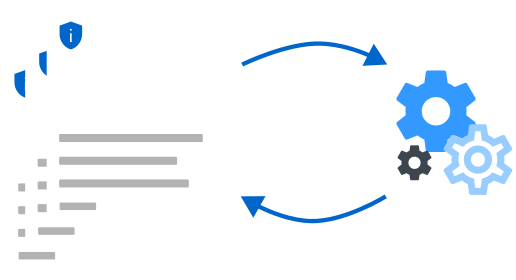
As manual processes reach their limits, automation, standardized rules, and testing become critical for ensuring consistent results.
Anonymized data can be used for evaluations, projects or for sharing with third parties – provided the anonymization is reliable.
Explore specific aspects in more detail or assess which formats and scenarios are relevant for your organization. We would be pleased to support you with an individual evaluation.
Overview of common formats, risks and appropriate anonymization methods.
Overview of risks resulting from improper anonymization.
Would you like to learn more about use cases, document types or the use of Project A? Get in touch with us — we will give you individual advice and show you the appropriate next steps.
Receive an offer


