
In the context of data protection, anonymization and pseudonymization are often equated. In fact, these are two fundamentally different concepts, each with their own legal and practical consequences.


Choosing the right method has a direct impact on whether or not data continues to fall under the GDPR. Miscalculations can lead to significant data protection risks.
Anonymized data are no longer considered personal data, as the identification of the data subject is no longer possible. Pseudonymized data, by contrast, remain personal data because re-identification is still possible through additional information and therefore continue to be subject to all GDPR requirements.
When pseudonymization is equated with anonymization, essential protective measures, documentation duties, and legal bases may be underestimated, creating potential compliance risks.
Anonymization aims to completely and permanently remove the personal reference from data.
Data is only considered anonymous if it are permanently outside of any identifiability. This means that neither individual characteristics nor their combinations may make it possible to assign them to a person. The decisive factor is whether re-identification is ruled out under realistic conditions — even in the case of additional knowledge or further technical processing.
If data is effectively anonymized, it loses its personal character. It therefore no longer falls under the provisions of the GDPR. Obligations such as purpose limitation, storage limitation, and data subject rights only apply as long as a link to a specific person exists. However, this requires that the anonymization is technically robust and permanently effective.
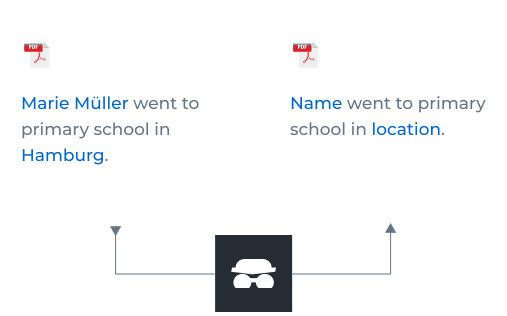
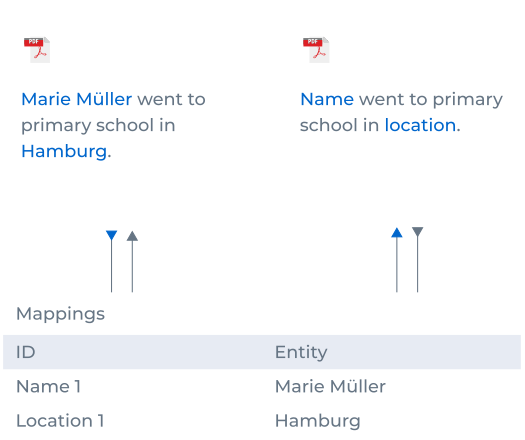
Pseudonymization replaces identifying attributes with identifiers or placeholders, but does not fully remove the link to an individual. In principle, re-identification remains possible as long as additional information is available. In practice, this is often achieved through a so-called mapping table, in which the identifiers used are linked to the original identifiers, enabling re-identification.
A typical example of such pseudonymization is shown in the illustration, where original identifiers are replaced with neutral values without fully anonymizing the underlying data structure.
Within the GDPR, pseudonymization is a recommended measure to reduce risks. It simplifies data handling but does not replace a legal basis.
In principle, re-identification remains possible, for example via keys, additional data or organizational access. As a result, all GDPR requirements continue to apply.
The two concepts differ in objective, risk and legal effect.
Anonymization completely removes the personal reference. Pseudonymization reduces it, but generally allows reassignment.
Anonymized data falls outside the scope of the GDPR. Pseudonymized data remains personal and must continue to be protected, documented and legally justified.
Anonymization is used for transfer, evaluation or archiving. Pseudonymization is suitable for internal analyses and processes with limited access.
The decision depends heavily on the respective use case, the purpose of data processing and the legal requirements.
As soon as data is to be passed on to third parties or evaluated over a longer period of time, complete anonymization is crucial in order to reliably comply with data protection obligations and to exclude any continuing personal reference.
For internal processes, test environments, or analyses with restricted access, pseudonymization can reduce the risk of unauthorized identification of individuals without completely eliminating the business data reference.
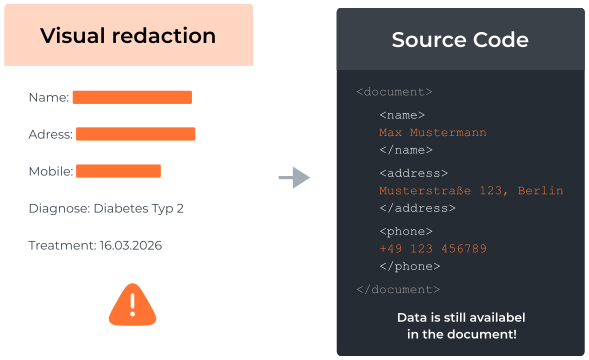
Many companies overestimate the protective effect of pseudonymization or implement anonymization incorrectly.
The exchange of names or identifiers does not result in anonymity. Pseudonymized data remains personal and continues to require compliance with all data protection requirements.
Visual redaction often doesn't remove data from the file. Re-identification remains possible without technical adjustment.
Explore specific questions in more detail or examine which formats and use cases are relevant for your company. We would be happy to assist you with an individual assessment.
Overview of formats, risks and appropriate anonymization channels.
Classification of risks and requirements for large amounts of data.
Would you like to learn more about use cases, document types or the use of Project A? Get in touch with us — we will give you individual advice and show you the appropriate next steps.
Receive an offer


